Jason L. Sanders
Royal Society University Research Fellow and Associate Professor, University College London
Galactic chronology in the era of Gaia — when and how the Milky Way's bar, disc and halo formed, and how they shaped one another.

I am a Royal Society University Research Fellow in the Astrophysics Group at UCL, studying how the Milky Way formed and evolved. Using Gaia and large photometric and spectroscopic surveys, I try to put dates on the key events in our Galaxy’s history — its last major merger, the formation of the bar and nuclear stellar disc, the growth and restructuring of the disc — and to understand how they are connected. This means measuring stellar ages (particularly with Mira variables), building dynamical models of the Galaxy’s structure, and using its stars to probe the dark matter. More on my research page, or see my and my group’s publications.
Before UCL, I was a postdoc and Junior Research Fellow in Cambridge, and did my DPhil in Oxford with James Binney — see my CV.
recent highlights
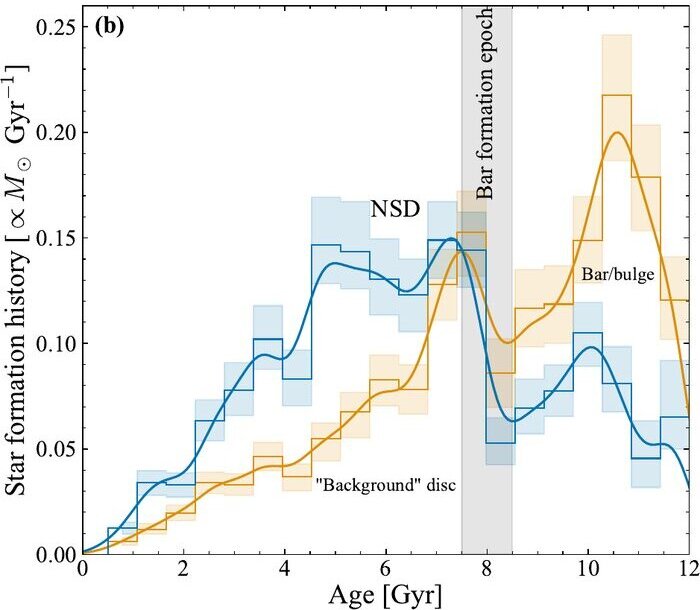
When did the Milky Way's bar form?
Mira variables in the nuclear stellar disc date the bar's formation to around 8 billion years ago.
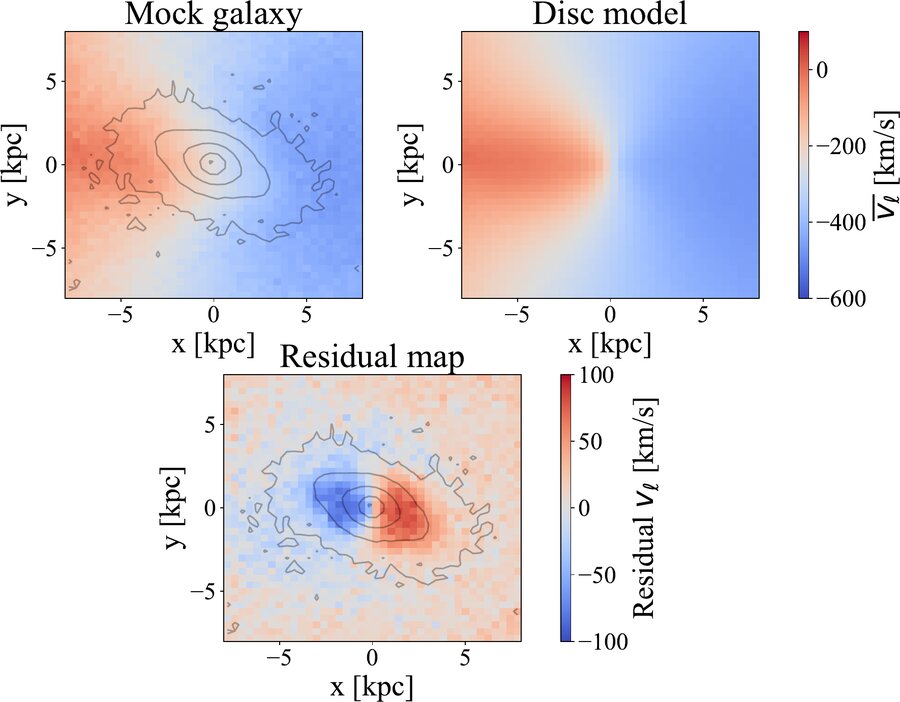
Dating the disc with the bar
Only stars born after the disc spun up were trapped by the bar, so the bar's imprint across Mira ages times the disc's formation.
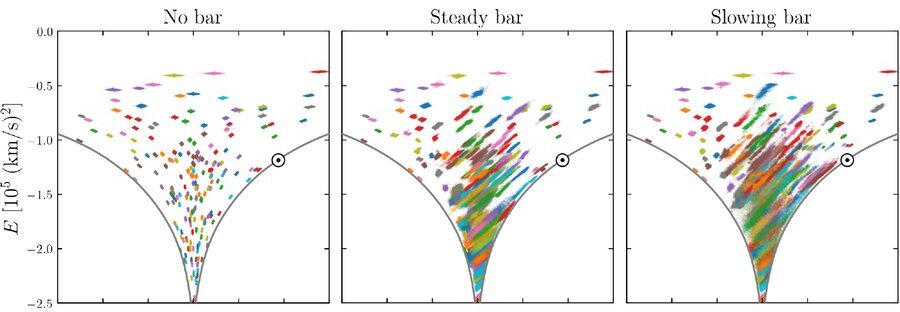
The bar scrambles the halo's history
A rotating, slowing bar spreads out low-energy debris in energy and angular momentum, so ancient substructure cannot stay clustered in these integrals of motion.
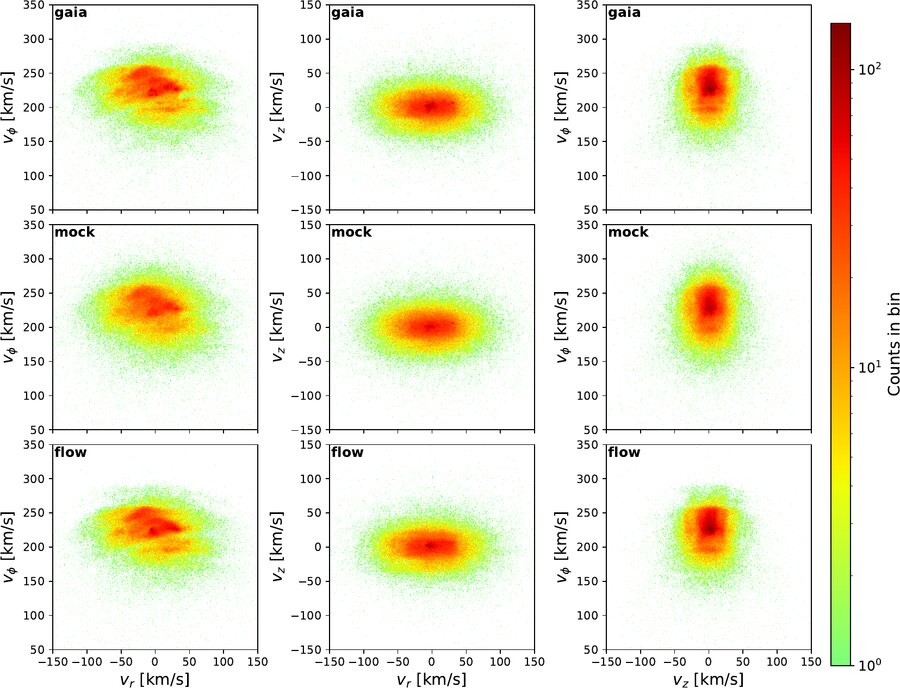
Denoising Gaia with normalizing flows
Normalizing flows recover the underlying velocity distribution from noisy survey data, capturing features like the Hercules stream and the phase spiral.
Weighing the Milky Way and the LMC
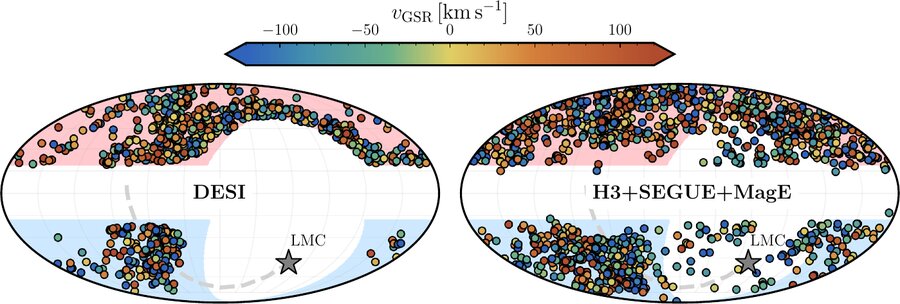
Simulation-based inference on outer-halo velocities measures the LMC-induced reflex motion and the masses of both galaxies.
Separating stellar populations by chemistry
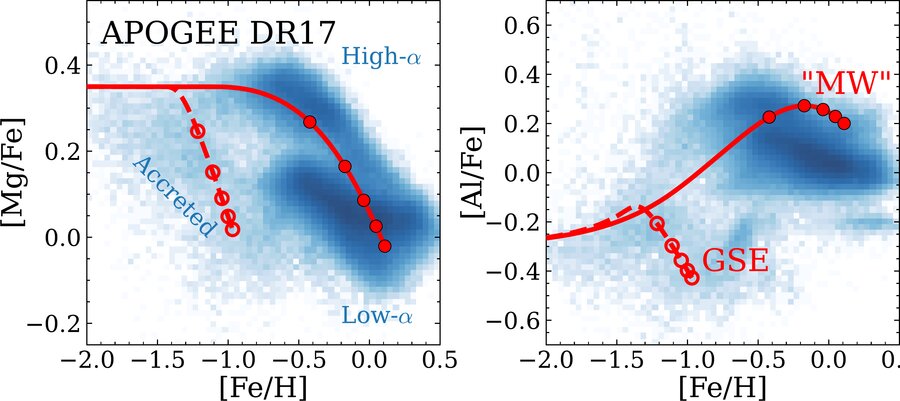
Analytic chemical evolution models with metallicity-dependent yields explain how aluminium separates the Milky Way's in-situ and accreted stars.
news
| Aug 12, 2026 | Congratulations to Richard Brooks on passing his PhD viva! Thanks to his examiners, Denis Erkal and Richard Ellis!  |
|---|---|
| Mar 13, 2026 | Another two excellent papers from Adam Dillamore and Richard Brooks on the arXiv. Adam has shown how the LMC can produce tilted triaxial figures from initially axisymmetric radially-anisotropic halo distributions. Richard has extended his SBI framework on the MW-LMC interaction to include measurements of the velocity dispersion of halo stars leading to precision constraints on the Milky Way and LMC masses. |
| Oct 07, 2025 | Two recent papers from Adam Dillamore and Richard Brooks on the arXiv. Adam’s work looks at the shape and tilt of the Milky Way’s dark matter halo by building equilibrium models of the tilted stellar halo, whilst Richard’s work provides constraints on the MW-LMC interaction from modelling kinematics of outer stellar halo stars using simulation-based inference. Congratulations both!  |
| Sep 22, 2025 | Welcome to Teresa Su who has just started a PhD with me. She will join the CDT Data Intensive Science programme! |
| Jul 14, 2025 | Richard Brooks has just submitted a great paper on simulation-based inference using stellar halo data for the Milky Way-LMC system. You can find it on the arXiv today. Richard shows how simple rigid simulations can capture the dynamics of more complex MW-LMC simulations (both controlled N-body and cosmological) and produce accurate inferences of the system parameters. This is super promising for application to the real data! Well done, Richard. |